Casino Self-Exclusion in Canada: A Player's Full Guide
KingCasinoBonus may earn a commission when you click a link or sign up through our site, and this can affect where products appear. To be clear, that commission never changes our scores, our analysis, or our recommendations. Ratings are based solely on our 11-step testing process, and we publish a casino’s drawbacks alongside its strengths.
Choosing to take a break from gambling is one of the most self-aware decisions you can make as a player. Canada has plenty of self-exclusion programs, available across every province, but the system is far more fragmented than most players realize.
There’s no single self-exclusion registry in Canada. Each province manages its own system, which is why the process ends up being fairly long and complicated.
This guide covers everything you need to know about casino self-exclusion – how to do it, how long it takes to kick in, and how you can ask for help along the way!
On this page
- What Is Self-Exclusion and How Does It Work?
- Self-Exclusion for Online Casinos in Canada
- How to Register for Self-Exclusion by Province
- What Self-Exclusion Actually Covers
- Where the Gaps Are – and What to Do About Them
- Online vs Land-Based Self-Exclusion – Are They Linked?
- How to Modify or Lift a Self-Exclusion
- If You Need Help Right Now
What Is Self-Exclusion and How Does It Work?
Self-exclusion is a voluntary agreement between you, as a player, and a gaming operator or provincial regulatory body, through which you block your own access to gambling for a set period. You’re the one who initiates this process. It’s not a penalty! It’s an official request that you make yourself.
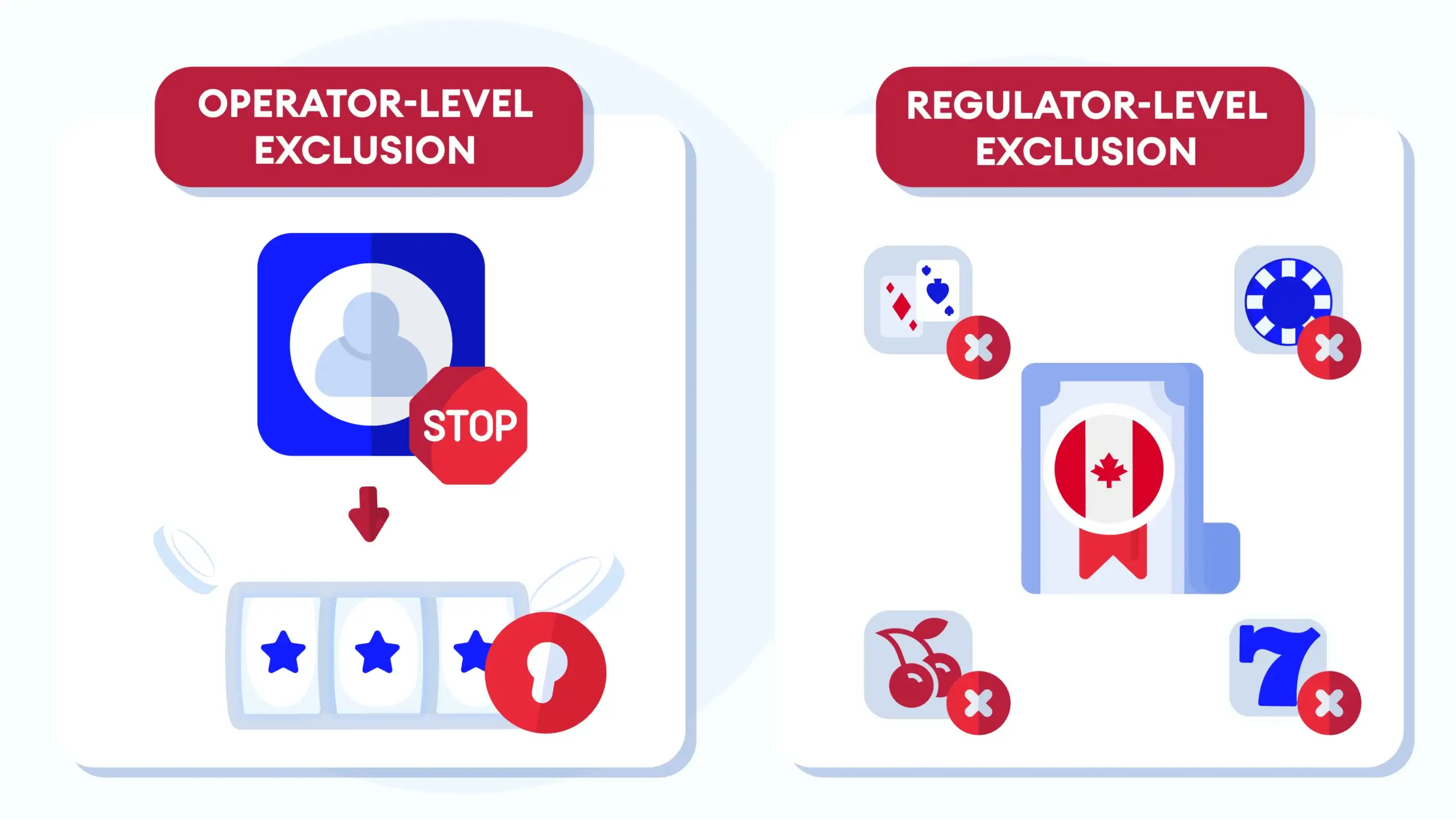
In Canada, there are two main types of self-exclusion:
Operator-level self-exclusion. In this case, you contact the casino directly and ask them to close your account. Here, you’re only excluded from that particular operator, not from any others. Keep that in mind!
Regulator-level self-exclusion is different. Here, you register with the gaming authority in your province, and your access gets blocked at every licensed casino. We’d say this is the most effective and advantageous option for a player who wants to stay away from gambling altogether.
Once you submit this request, all your accounts are closed, you’ll stop receiving marketing communications and promotions, and you’ll no longer have access to physical casinos. If you try to enter a physical casino, you’ll be asked for ID. At larger venues, facial recognition is also used.
When you make a request like this, you’ll also choose the duration. Generally, it starts at 6 months, but you can also opt for a lifetime ban. If you’re not sure how long you need, go with the shortest option first – you can always decide later. You can extend the period once it expires.
The KingCasinoBonus team’s take
Our team is honest with our readers, so we’ll also tell you what self-exclusion can’t do. It can’t completely eliminate the underlying urge. Most specialists recommend combining self-exclusion with some form of additional support. You could go for counselling, for example, or peer support through Gamblers Anonymous.
Self-Exclusion for Online Casinos in Canada
The online casino market in Canada is split between regulated sites and unregulated offshore sites. Unfortunately, self-exclusion works very differently depending on which one you’re dealing with.
From everything we’ve looked into, Ontario clearly has the best system in place. iGaming Ontario runs a self-exclusion program called BANS, which stands for Be A Network of Support. You can register with BANS and you’ll be automatically blocked from every site licensed by iGaming Ontario. The good news is that, as of 2026, dozens of operators hold an Ontario license, so a single BANS registration protects you across a large number of casinos.
Unfortunately, the other provinces don’t have a similarly unified system. All you can really do is self-exclude separately from each individual casino.
Another issue most players run into is offshore casinos. Many Canadian players gamble on sites that aren’t licensed, which means those operators aren’t legally required to honour Canada’s provincial self-exclusion registers. So say you self-exclude through iGaming Ontario – you’d still be able to access offshore casinos without any problem.
So what’s our solution for this?
We’ve put together a couple of options. You can reach out to each offshore site individually and request voluntary self-exclusion. It’s a more tedious process, but not an impossible one. Another thing you can do is use blocking software built specifically for gambling sites – Gamban or Betfilter, for example. These tools work at the device level and block your access to anything gambling-related, completely.
Our recommendation is to combine classic casino-level self-exclusion with a tool like Gamban, which will help keep offshore casinos out of reach too.
How to Register for Self-Exclusion by Province
The registration process varies from province to province. Check out the province you play in using the table below! That said, we still recommend double-checking the exact steps directly with the authority in your province, since procedures do get updated from time to time.
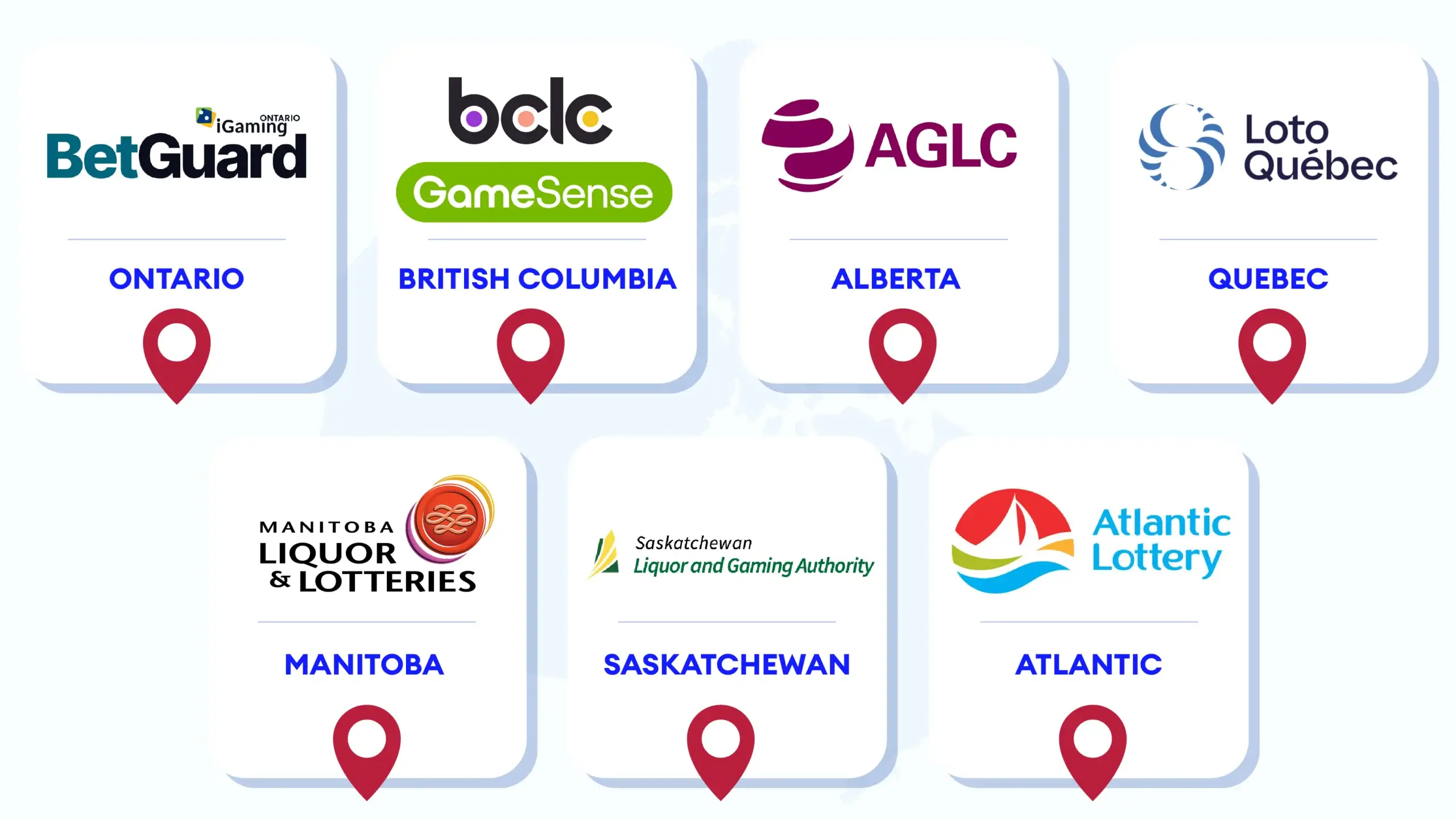
| Province | Program / Authority | How to Register | What It Covers | Duration Options |
|---|---|---|---|---|
| Ontario | iGaming Ontario – BANS + OLG | Sign up online at igamingontario.ca, or stop by any OLG casino or Gateway location in person | Every site licensed by iGaming Ontario, plus OLG’s retail casinos and slot machines | 6 months, 1, 2, 3 years, or lifetime |
| British Columbia | BCLC / GameSense | Register online at bclc.com/play-responsibly, or visit any BCLC casino or community gaming centre | PlayNow.com and every casino or gaming centre BCLC operates | 3 months, 1, 2, 3 years, lifetime |
| Alberta | AGLC – Voluntary Self-Exclusion | Apply online at aglc.ca, or give them a call at 1-800-522-4700 | All AGLC-licensed casinos, racing entertainment centres, and lottery retailers, plus PlayAlberta.ca | 6 months, 1, 3 years, or lifetime |
| Quebec | Loto-Quebec / Mise-O-Jeu | Register online at lotoquebec.com, or in person at any Loto-Québec casino | Loto-Québec’s casinos (Montreal, Quebec City, Mont-Tremblant, Charlevoix), plus Espacejeux.com | 6 months, 1, 2 years, or lifetime |
| Manitoba | MBLL – Manitoba Liquor and Lotteries | Visit any Manitoba casino in person, or call 1-800-463-1554 | Every MBLL-operated casino and VLT location, plus PlayNow Manitoba | 6 months, 1, 3 years, or lifetime |
| Saskatchewan | SLGA | Register online at slga.gov.sk.ca, or visit any Saskatchewan casino in person | All SLGA-licensed casinos and gaming facilities | 6 months, 1, 3 years, lifetime |
| Atlantic Provinces | ALC – Atlantic Lottery Corporation | Sign up online at alc.ca, or visit a participating ALC venue in person | ALC’s casinos, gaming sites, and the ALC.ca online platform | 6 months, 1, 3 years, or lifetime |
Keep in mind that the legal minimum gambling age is 19 in Ontario, British Columbia, and Saskatchewan, and 18 in Quebec, Manitoba, and Alberta. Once you’ve reached the legal age and can register at casinos, you can also opt for self-exclusion.
Here’s a tip from us: when you self-exclude from a casino, be sure to request written confirmation that includes the date the self-exclusion takes effect and its duration. If you ever end up in a dispute with the casino, having that proof on hand will work in your favour.
If you’re worried you won’t be able to handle the process, don’t be. Self-exclusion is straightforward – all you need is a few spare minutes. Just have a piece of ID on hand, and in some provinces, you’ll also be asked to sign a form confirming that you understand the terms of the exclusion.
What Self-Exclusion Actually Covers
If you’ve self-excluded from a regulated online casino, the measure takes effect as soon as your registration is processed. From that point on, you won’t be able to log in, any pending bonuses will be cancelled, and your money will be returned to your payment method.
From that same moment, marketing communications stop. All licensed operators are required to remove you from every direct marketing campaign, whether we’re talking about emails, SMS messages, or push notifications.
At physical casinos, how this gets enforced can vary from one location to another. Some larger casinos use photo databases, and staff will ask for ID at the entrance. A few casinos in Ontario and British Columbia also use facial recognition technology. If you’re an excluded player, the system will identify you quickly and deny you access.
In Ontario and British Columbia, if an excluded player still manages to gamble and ends up winning, the operator is legally required to withhold that money. Keep in mind that self-exclusion isn’t just a formality – it comes with real financial consequences!
Where the Gaps Are – and What to Do About Them
The biggest gap, for most players, is offshore casinos. As we mentioned, offshore casinos aren’t required to follow any provincial self-exclusion register. In this situation, you can either self-exclude individually from each casino, or install device-level blocking software like Gamban. Combining these two layers of protection helps keep you away from gambling altogether.
Provincial borders limit your coverage
If, say, you self-exclude in Ontario, that means you won’t be protected in BC or Alberta. If you travel often or live near a provincial border, we’d recommend self-excluding separately in each one. The process is pretty much the same everywhere, so it won’t take much effort on your part.
Also keep in mind that online and physical casinos are treated separately. If you self-exclude from online casinos, you’ll still be able to walk into physical ones, and vice versa. If you want full protection, exclude yourself from both separately. Alberta is the one exception there, a single AGLC registration covers both.
As for US and international casinos, you’d need to self-exclude separately or look into whatever options are available there. That’s mainly relevant if you’re planning to travel and are worried you might end up gambling.
There’s also private or social gambling card games at home, betting among friends which obviously isn’t covered by any official program. That comes down to your own personal judgment and, why not, an honest conversation with the people around you.
We’ll be straight with you! Until every province adopts the kind of clearly regulated model Ontario has, the most practical solution remains combining provincial self-exclusion with protective tools like Gamban. Keep in mind the advice from the experts at KingCasinoBonus CA.
Online vs Land-Based Self-Exclusion – Are They Linked?
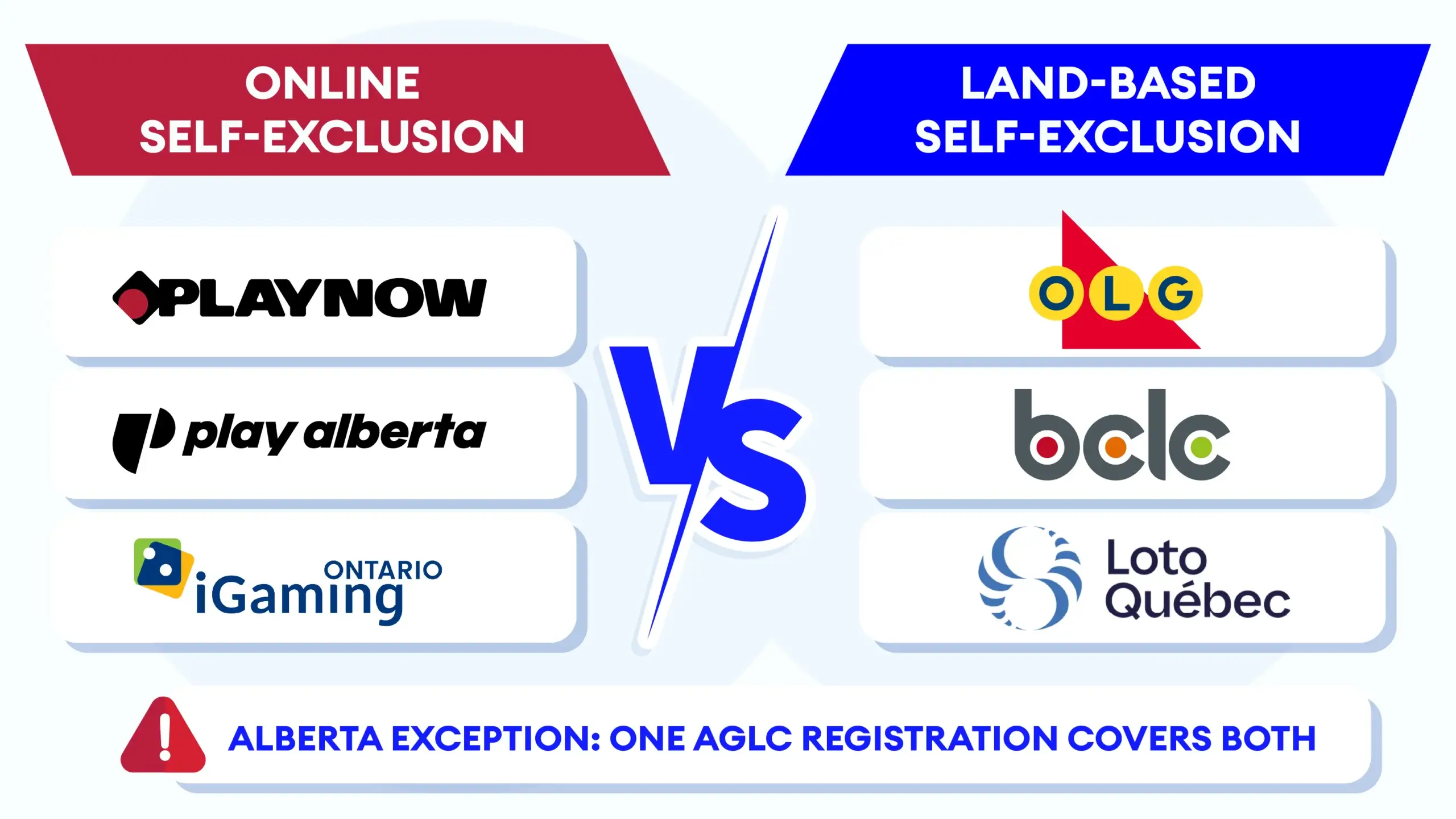
A lot of players assume that once they’ve self-excluded online, they’ll automatically be excluded from physical casinos too, or vice versa. Unfortunately, that assumption is completely wrong, so don’t rely on it!
Let’s say you register separately with OLG for physical venues too – you could still walk into a land-based casino in Ontario. These are two completely separate, independent programs.
The same situation applies in British Columbia. Registering with BCLC to exclude yourself from PlayNow won’t automatically exclude you from BCLC’s physical casinos across the province either. What you can do is register for both at the same time.
Right now, Alberta has the best self-exclusion system out of all the provinces. All you need to do is register with AGLC, and you’ll be automatically excluded from both the PlayAlberta online platform and every AGLC-licensed physical venue.
Your best bet is to do your homework, and whenever you want to self-exclude and aren’t sure how, just ask the casino staff. Check whether a single registration form excludes you from both online and physical casinos, or whether you need to go through an additional process. Always ask for confirmation!
How to Modify or Lift a Self-Exclusion
Keep in mind that self-exclusion is only permanent if you choose the lifetime ban option. Shorter periods are also available: 6 months, 1 year, or 3 years. Once you apply for this option, you have to wait out the full period before you can play again.
The good news is that most provinces don’t restore your access automatically once the term expires. You have to submit a request in person to have your self-exclusion lifted. What’s more, there’s a waiting period between the moment you submit your request and the moment your access is actually restored. In Ontario, this waiting period is 30 days. In British Columbia, you need to meet with a GameSense counsellor before your request gets approved. These waiting periods aren’t random – they give you extra time to think it over!
If your exclusion period ends and you haven’t submitted a request for reinstatement, you’ll remain excluded. You’re responsible for that decision, not the casino or the regulatory authority. This can actually work in your favor, since the path of least resistance ends up being continued self-exclusion rather than continued gambling.
In most provinces, you can’t shorten an active exclusion. If you sign up for three years and change your mind after six months, you won’t be able to cut the period short. That’s why we recommend starting with a shorter term, you can always extend it later on.
If You Need Help Right Now
Self-exclusion only blocks your access to gambling – it can’t resolve the underlying causes behind problematic behavior. Self-exclusion works best when it’s paired with support, such as talking to a counsellor, joining a support group, or even having conversations with family members.
If you’re dealing with this kind of problem yourself, or you know someone struggling with a gambling addiction, here are Canadian resources you can reach out to at any time:
- Responsible Gambling Council (rgco.org) – Offers free self-assessment tools, educational materials, and referrals to local support services.
- Gambling Therapy (gamblingtherapy.org) – Provides a 24/7 online chat where you can talk one-on-one, plus a forum where you can read about other players’ experiences.
- CAMH (Centre for Addiction and Mental Health) (camh.ca) – Canada’s largest hospital specializing in mental health and addiction.
- Gamblers Anonymous Canada (gacanada.ca) – Support meetings are a good option if you want to hear stories from people with similar experiences. They’re available both online and in person.
If you feel like gambling is causing problems in your life, the first step you can take is to self-exclude. You can choose to take a short break or step away indefinitely. Keep in mind all the advice given in this article! You can also find a full set of responsible gambling tools and resources at KingCasinoBonus.ca.